


What are the most dangerous drugs?
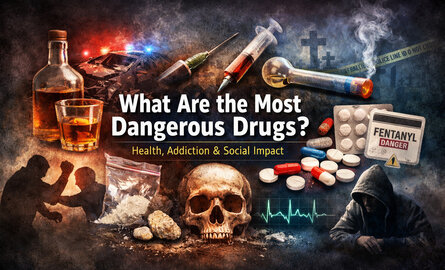
Heroin, cocaine and methamphetamine are often mentioned as the most dangerous drugs. Still, “dangerous” depends on what you measure: addiction risk, health harm, overdose risk and/or social consequences. Researchers combine these factors in rankings. In this article, you’ll read which substances score highest for overall harm — and why alcohol often ends up surprisingly near the top.
The “most dangerous” drug is the substance that causes the greatest total harm: harm to the user (health, addiction, death) and harm to others (accidents, violence, healthcare and social costs). In multiple studies, alcohol therefore scores very high.
How is drug dangerousness measured?
Researchers often use a multicriteria decision analysis (MCDA). This assigns substances scores across multiple criteria, such as mortality, addiction, physical and psychological harm, and social consequences. A well-known example is the 2010 MCDA study (The Lancet), in which substances are ranked by total harm (user + society): Nutt et al. (2010)1.
- Risk of death (overdose, physical harm)
- Likelihood of addiction or dependence
- Psychological and neurological harm
- Social and societal consequences (nuisance, crime, costs, harm to family or community)
A drug can be “dangerous” because of high overdose risk, because it is highly addictive, or because the societal harm is large. MCDA combines these effects into a single overall score.
Ranking: which substances are among the most dangerous drugs?
Based on MCDA studies and recent signals around new substances, the following groups are often mentioned as high-risk, especially when looking at total harm.
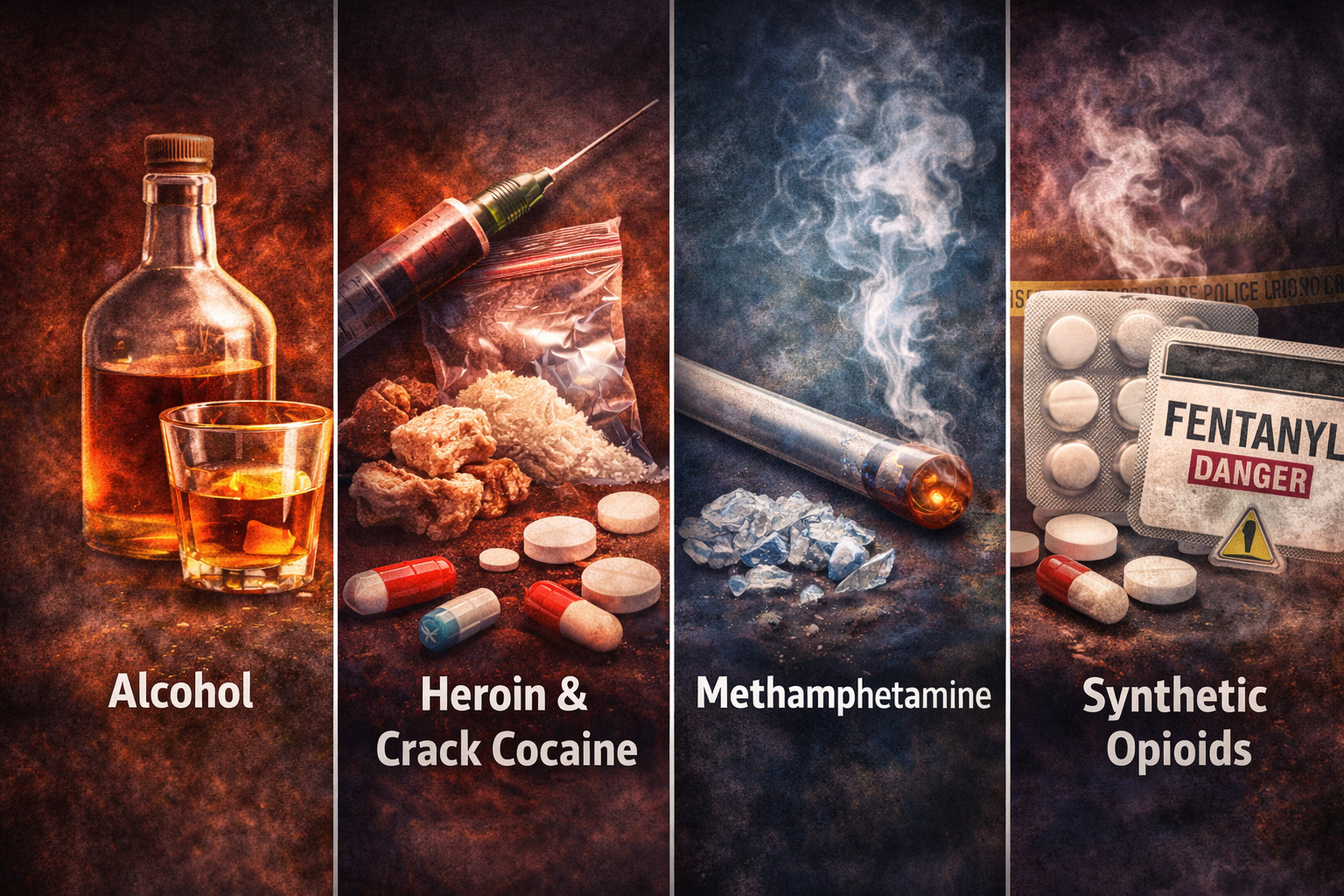
1) Alcohol: legal, but particularly harmful
Alcohol is legal, yet it can score very high for total harm. It increases the risk of a wide range of conditions and also causes societal harm, such as accidents, violence and absenteeism. In the Netherlands, Trimbos also points to substantial societal costs and harm to others2.
Also read: Drugs that go unnoticed: alcohol3.
2) Heroin and (crack) cocaine: extremely dangerous for the user
Heroin and crack cocaine score high for harm to the user. They are associated with strong addiction, a high risk of physical and psychological problems and — for opioids — a substantial overdose risk. The fast and intense effects of crack cocaine increase the likelihood of problematic use.
3) Methamphetamine and other strong stimulants
Methamphetamine and similar stimulants can lead to severe physical and mental harm and often cause social disruption and long-term problems in daily functioning.
4) Synthetic opioids and new psychoactive substances (NPS)
In addition to classic drugs, synthetic opioids and new psychoactive substances pose a growing risk. International reports signal ongoing problems related to drug markets and health harms4. In the Netherlands, since 2025 entire substance groups, such as fentanyl analogues, have been brought under the Opium Act5.
What should you consider when assessing drug risks?
When estimating risks, it’s important to look beyond just the name or legality of a substance. “Dangerousness” is determined by a combination of factors.
Alcohol is a clear example: despite its legal status, alcohol can score highly for total harm because it causes health problems for users as well as major societal consequences.
In addition, “danger” varies by perspective. If you look at total harm (user + society), alcohol may rank at the top. If you focus mainly on risk to the user, heroin, crack cocaine and synthetic opioids are often considered the most dangerous.
Finally, risks differ from person to person. Factors such as health, mental state, dosage, frequency of use and polydrug use largely determine how dangerous a substance is in practice.
Is alcohol more dangerous than drugs?
In multiple rankings based on total harm, alcohol scores higher than many illegal drugs, mainly due to the combination of health risks and major societal impact.
What is the most dangerous drug in the world?
That depends on the measurement method: by total harm, alcohol often ranks very high; by risk to the user, heroin and (crack) cocaine often rank at the top.
Which drug is the most addictive?
Heroin is among the most addictive substances. Crack cocaine and methamphetamine also have a high risk of dependence. Alcohol and nicotine are often underestimated but are also strongly addictive.
Drug law in the Netherlands: hard drugs vs soft drugs
In the Netherlands, the law distinguishes between hard drugs (Opium Act List I) and soft drugs (List II). Explanations and examples can be found via the Dutch government6. For new psychoactive substances, additional bans apply to entire substance groups7.
Reducing harm: practical safety tips
- Avoid mixing — polydrug use greatly increases risks.
- Know what you have: contamination and misrepresentation occur.
- Pay attention to set & setting during psychedelic experiences.
- Seek help if there are signs of addiction or loss of control.
Read more about this topic
- Drugs that go unnoticed: alcohol
- Drug testing (category) – practical tools for checking substances.
- Set & setting explained
- A bad trip: what is it and how can you prevent it?
- Microdosing (category)
- Magic truffles (info & assortment)
Sources
- Nutt et al. (2010)– MCDA ranking (total harm to user + society).
- Trimbos – societal harm from alcohol.
- UNODC – World Drug Report (2024).
- Dutch government – ban on designer drugs.
- Difference between hard drugs and soft drugs.
- Designer drugs ban (1 July 2025).
Disclaimer: The information in this article is intended as general background and is not medical advice. If you have questions about substance use, addiction or health, consult a professional.